


Direct answer: Clean between your teeth once a day. Use string floss or dental tape where contacts are tight, and use an appropriately sized interdental brush where there is enough space for it to pass gently. The best tool is the one that fits your teeth, you can use consistently, and does not cause injury. If you are unsure which size or method is right, a dental professional can demonstrate it during a preventive visit.
A toothbrush cleans the outer, inner, and chewing surfaces of teeth, but its bristles do not effectively reach many of the spaces between teeth. Those areas can collect food and dental plaque, a sticky film of bacteria. Daily interdental cleaning helps disrupt that plaque before it hardens into calculus, also called tartar. Once tartar forms, it cannot be removed safely with floss or a toothbrush; it requires professional dental instruments. [1] [2] [3]
Why cleaning between teeth matters
Plaque around and between teeth can irritate the gums. Early plaque-related inflammation is called gingivitis; gums may look red, feel tender, or bleed when brushed or cleaned. Daily brushing and interdental cleaning can help control plaque, but bleeding that persists, becomes heavy, or is accompanied by pain, swelling, pus, loose teeth, or a bad taste should be evaluated rather than ignored.
The evidence does not show that one device is universally best. A Cochrane review found that adding floss or interdental brushes to toothbrushing may reduce gingivitis or plaque more than toothbrushing alone. Interdental brushes may help gingivitis more than floss in some short-term comparisons. However, the evidence was low to very low certainty, most studies were short, and no included studies measured prevention of between-teeth cavities. The practical lesson is not to promise a guaranteed result; it is to clean the surfaces a toothbrush misses with a method you can use correctly. [4]
Choose the right between-teeth cleaner
String floss or dental tape for tight contacts
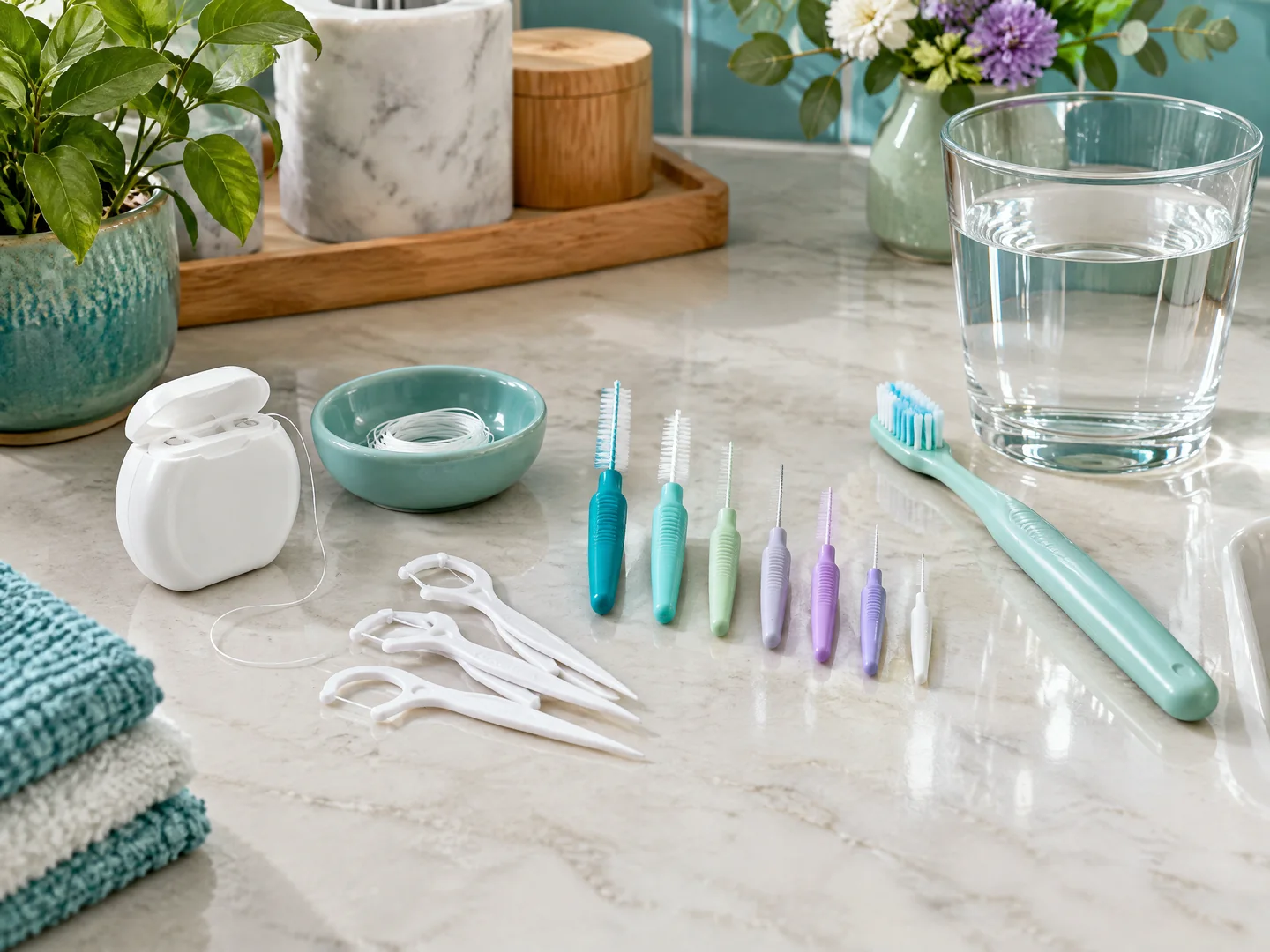
Floss is a smooth strand designed to slide through a tight contact between teeth. Dental tape is wider and flatter, and some people find it more comfortable. Waxed and unwaxed floss can both be useful; the important factors are access, comfort, and technique. A floss holder or pre-threaded flosser may help if wrapping floss around your fingers is difficult.
Do not use fingernails, paper, forks, pins, or other improvised objects to remove food. They can injure the gum or damage a restoration. If a contact is too tight for ordinary floss, do not force it. A floss threader or a different type of floss may help, but persistent difficulty should be checked by a dentist.
Interdental brushes for open spaces
Interdental brushes have a small head and come in different sizes. They can be useful where the space between teeth is open enough for bristles to contact the tooth surfaces. People with gum recession, spaces created by missing teeth, or certain dental work may need more than one size in different parts of the mouth.
Start with a small brush or ask a dental professional to recommend a size. The brush should pass with gentle resistance and its bristles should contact the sides of the teeth. Never force it. The wire should not scrape the teeth, gums, crowns, or implants. If the brush bends sharply, catches, or cannot enter without pressure, choose a smaller size or another tool. A snug, comfortable fit is more important than using a larger brush.
Water flossers, threaders, and other aids
A water flosser can direct a stream of water around and between teeth. It may be useful for someone who has limited hand control or finds string floss difficult, and it can help reach around some bridges or braces. A water flosser is not a reason to skip brushing, and it does not replace professional removal of tartar. Follow the device instructions and ask your dental team how to use it around restorations or appliances.
Floss threaders can guide floss beneath a bridge or around orthodontic components. Small brushes may also help in these areas. Because dental work and gum contours vary, ask for individualized instructions if you have braces, a bridge, a crown, an implant, a retainer, or another appliance.
How to floss correctly, step by step
- Use enough floss. Break off roughly 18 inches, or about two feet, and wind most of it around a middle finger on one hand and the remainder around the opposite middle finger. Move to a clean section as you work.
- Control the strand. Hold a short section tightly between your thumbs and forefingers. Relax your hands enough to guide the floss rather than snap it.
- Enter the contact gently. Use a small back-and-forth rubbing or sawing motion to ease the floss between the teeth. Never force or snap it into the gum tissue.
- Form a C shape. When the floss reaches the gumline, curve it around one tooth so it hugs the tooth in a C. Slide it gently just under the gum edge, only as far as comfortable.
- Clean the first tooth surface. Hold the floss against the tooth and move it up and down several times. The goal is to wipe the side of the tooth, not merely pass through the contact.
- Clean the neighboring surface. Curve the same section around the adjacent tooth and repeat. Each space has two tooth surfaces to clean.
- Follow a pattern. Work around the upper teeth and lower teeth in the same order each day. Include the back side of the last tooth in each row.
MouthHealthy and NIDCR both emphasize gentle entry, a C-shaped curve, and cleaning along each tooth. [2] [3] If your technique is uncomfortable even after you slow down and reduce pressure, stop forcing the area and ask for help. NIDCR specifically identifies snapping floss through a contact as a common mistake. [5]
How to use an interdental brush
Use a mirror at first if it helps, but focus on how the brush feels. Guide the brush straight through the space between front teeth. For back teeth, a small brush with a flexible neck or a long-handled model may make access easier. Move the brush through its full length a few times, without scrubbing aggressively. Clean every space once daily, replacing the brush when the bristles are worn or the wire is damaged.
A professional demonstration is worthwhile when spaces differ across your mouth. One size may fit the front teeth while a smaller or larger size fits the back. If a brush repeatedly catches, causes sharp pain, or leaves the gums sore, it may be the wrong size or the area may need evaluation. Do not bend and straighten a wire repeatedly or use a damaged brush.
When should you floss: before or after brushing?
Either order is acceptable if the cleaning is thorough. Some people clean between teeth first so loosened debris can be brushed away. Others prefer to brush first and floss later. The American Dental Association’s practical recommendation is to clean between teeth once daily at a time that fits your routine. Evening is convenient for many people, but a consistent morning or midday habit is better than an ideal schedule you cannot maintain. [1]
Continue brushing twice daily with fluoride toothpaste as directed by your dental professional. Interdental cleaning complements brushing; it does not replace it. It also does not replace a dental cleaning and exam, especially when tartar or gum inflammation is present.

What if your gums bleed?
A small amount of bleeding can occur when inflamed gums are disturbed by cleaning. It may improve as plaque is removed and the tissues become healthier, but bleeding is not a reason to use more force. Use a clean, gentle technique and monitor the pattern.
Arrange a dental evaluation if bleeding continues despite careful daily cleaning, occurs spontaneously, is substantial, or comes with swelling, tenderness, persistent bad breath, pus, a loose tooth, or a change in how your teeth fit together. Severe facial swelling, difficulty breathing or swallowing, uncontrolled bleeding, or a serious dental injury warrants urgent care. A dental professional can determine whether the issue is plaque-related gingivitis, tartar, a restoration problem, trauma, or another condition.
Cleaning between teeth around braces and dental work
Brackets, wires, bridges, crowns, implants, and retainers create additional surfaces where plaque can collect. They do not automatically dictate one universal tool. A floss threader, orthodontic brush, interdental brush, or water flosser may be appropriate depending on the appliance and the spaces around it. Use the method shown by the clinician who placed or maintains the appliance, and do not force a brush or floss under a component.
If food repeatedly catches in one location, the area bleeds, or a floss strand shreds, schedule an assessment. The problem may be technique, an open contact, a rough edge, gum changes, or a restoration that needs attention. A personalized demonstration during a professional dental cleaning and exam can make the routine more comfortable and precise.
A simple daily routine
Choose one tool for tight spaces and another for open spaces if needed. Keep the tool where you will see it. Clean between teeth once daily, then brush twice daily with fluoride toothpaste. Use light pressure and a repeatable pattern. Do not reuse disposable floss or a worn interdental brush; used products can fray or lose effectiveness. [1]
If you are developing a new routine, start by cleaning one section carefully and build toward every space. A dental hygienist or dentist can show you where plaque remains, identify the right interdental-brush sizes, and explain how to work around dental restorations. Home care and professional care serve different purposes: home cleaning disrupts daily plaque, while a professional cleaning removes deposits that have hardened.
Frequently asked questions
How often should I clean between my teeth?
Aim for once a day. The exact time matters less than doing a complete, gentle routine consistently. The ADA and NIDCR both support daily interdental cleaning as part of oral hygiene. [1] [3]
Is an interdental brush better than floss?
Not for every mouth. Floss or tape often suits tight contacts. An interdental brush may be more effective or easier where spaces are open enough for bristles to contact both teeth without force. A dental professional can check fit and technique.
Why do my gums bleed when I floss?
Bleeding can be associated with plaque-related gum inflammation, but it can also reflect trauma from snapping or pressing floss. Slow down, use a C shape, and avoid force. If bleeding persists, is heavy, or comes with pain or swelling, arrange a dental evaluation.
Should I floss before or after brushing?
Either is acceptable when you clean thoroughly. Choose the order that helps you make interdental cleaning a daily habit. Some people prefer flossing first so loosened debris can be brushed away. [1]
Can I use a water flosser instead of string floss?
A water flosser is one accepted type of interdental cleaner and may improve access for some people. It can be useful around certain dental work or when hand control is limited. Ask your dental team for appliance-specific instructions, and continue brushing.
How do I clean between teeth with braces, a bridge, or a retainer?
Use only the tool and technique recommended for your appliance. A threader, small brush, or water flosser may help, but the correct approach depends on the design and the spaces around it. Ask for a demonstration rather than forcing floss or a brush.
Need help choosing a tool?
If you are looking for a dentist in Garden City MI and want help with bleeding, food trapping, tartar, or interdental-brush sizing, Garden City Family Dentistry can discuss your concerns during a preventive dental visit. The practice offers professional dental cleaning and exam services at 7110 Venoy Road, Garden City, MI 48135. Call (734) 522-6340 to ask about an appointment. Garden City Family Dentistry serves Garden City, Westland, Dearborn Heights, Livonia, Canton, and Metro Detroit.
For more information about the practice’s approach, see preventive dentistry or contact Garden City Family Dentistry. This article is general education and does not replace an examination or individualized instructions.
Clinical-review note: Final practice clinical review and approval are required before publication.