

Stable Support
Implants can support a crown, bridge, or denture and may feel more secure than a traditional removable option.

Restore your ability to chew, speak, and smile with confidence through personalized dental implant care and natural-looking tooth replacement.
Medically reviewed by Dr. Reich and Dr. Laing · Garden City Family Dentistry · Last updated September 16, 2026 · Educational purposes only.
A dental implant is a small, biocompatible titanium post placed in the jawbone to act as an artificial tooth root.
After healing, a custom crown, bridge, or denture can be attached to the implant. The result is a stable tooth-replacement foundation designed to look, feel, and function naturally when appropriate for your needs.

Missing teeth can affect chewing, speaking, confidence, and the way you care for the rest of your mouth. Dental implants are designed to provide a stable foundation for a crown, bridge, or denture.
At Garden City Family Dentistry, implant planning begins with an evaluation of your oral health, bone structure, goals, and restoration needs. The team will explain the steps, timing, comfort options, and alternatives before you decide.
Plan Your Implant ConsultationDental implants may be considered when you want a fixed or more stable tooth-replacement option. The right approach depends on your clinical evaluation.
Implants can support a crown, bridge, or denture and may feel more secure than a traditional removable option.
A custom restoration is planned to complement the surrounding teeth, smile, and bite.
Tooth replacement may help support chewing and speaking when the restoration and bite are properly planned.
Imaging helps the team evaluate bone, nearby structures, and restoration goals before treatment.
Every option has advantages and limitations. Your consultation should include a review of oral health, bone support, adjacent teeth, budget, timeline, and long-term maintenance.
| Consideration | Dental implant | Dental bridge | Removable denture |
|---|---|---|---|
| Support | Uses an implant post as an artificial tooth root. | Anchors an artificial tooth to neighboring teeth or implants. | Rests on the gums and may use clasps or adhesives. |
| Adjacent teeth | Designed to be self-supporting for a single tooth replacement. | May require preparation of supporting teeth. | Does not require preparation of adjacent teeth for support. |
| Removability | Restoration is generally fixed after completion of the plan. | Usually fixed in place. | Removed for cleaning and often overnight. |
| Timeline | Includes healing and restoration stages. | Often completed in fewer stages, depending on the case. | Timing varies based on impressions, design, and delivery. |
| Best fit | Patients seeking a fixed replacement who meet clinical requirements. | Patients for whom a bridge is appropriate. | Patients who need or prefer a removable tooth-replacement option. |
Garden City Family Dentistry can discuss the restoration option that best matches your goals and clinical needs.
Replace one missing tooth with an implant-supported crown designed to blend with the surrounding smile.
Learn about single implants →
Use dental implants to help anchor a removable denture and improve stability compared with traditional removable dentures.
Explore implant-supported dentures →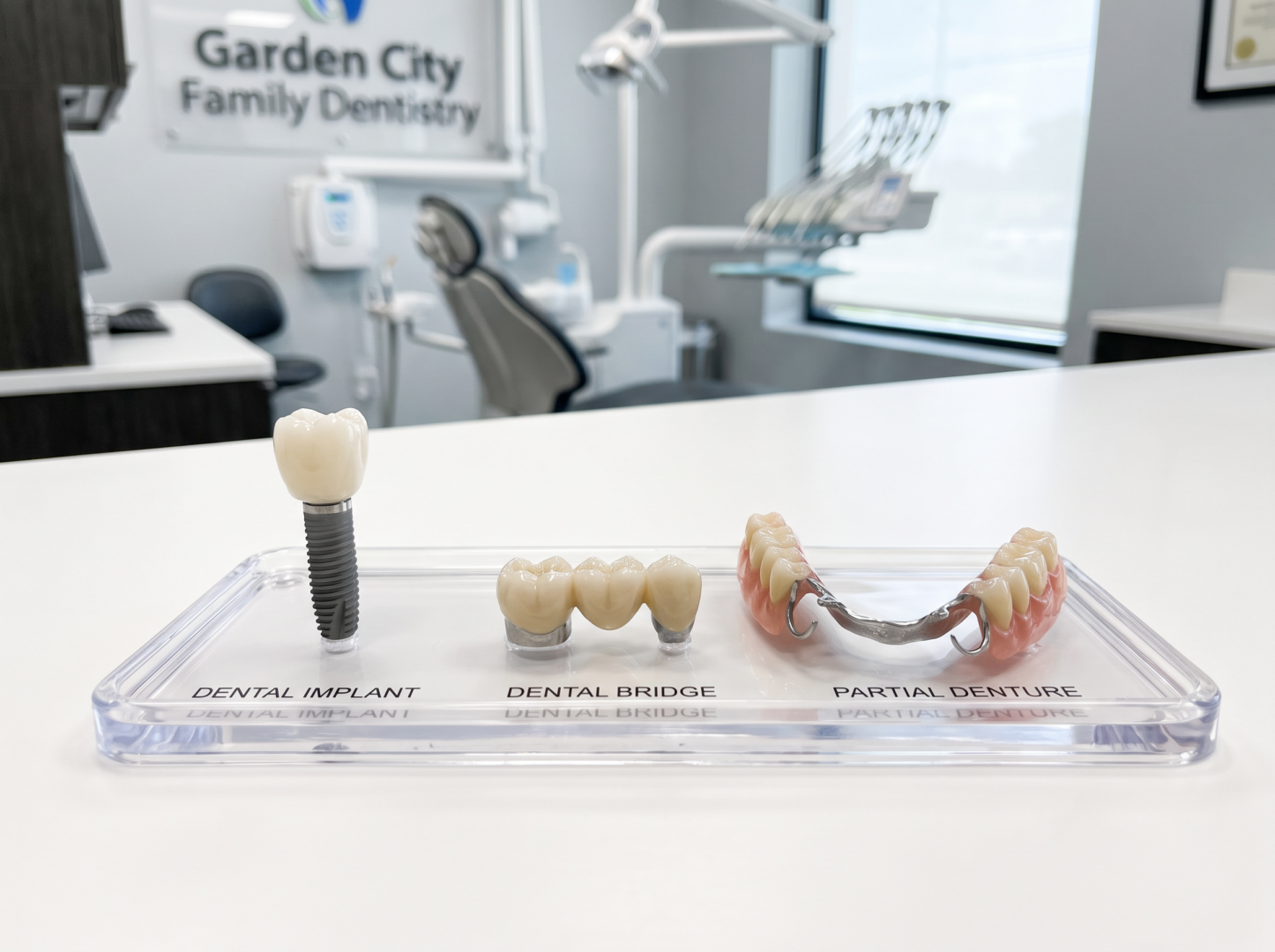
Discuss whether a crown, bridge, or denture is the right restoration to complete your implant plan.
Explore restorative dentistry →Implant candidacy depends on your oral health, bone volume, gum health, medical history, smoking status, bite, and the type of restoration you need.
If bone volume is limited, additional procedures may be discussed. Your digital imaging consultation will guide the recommendation.
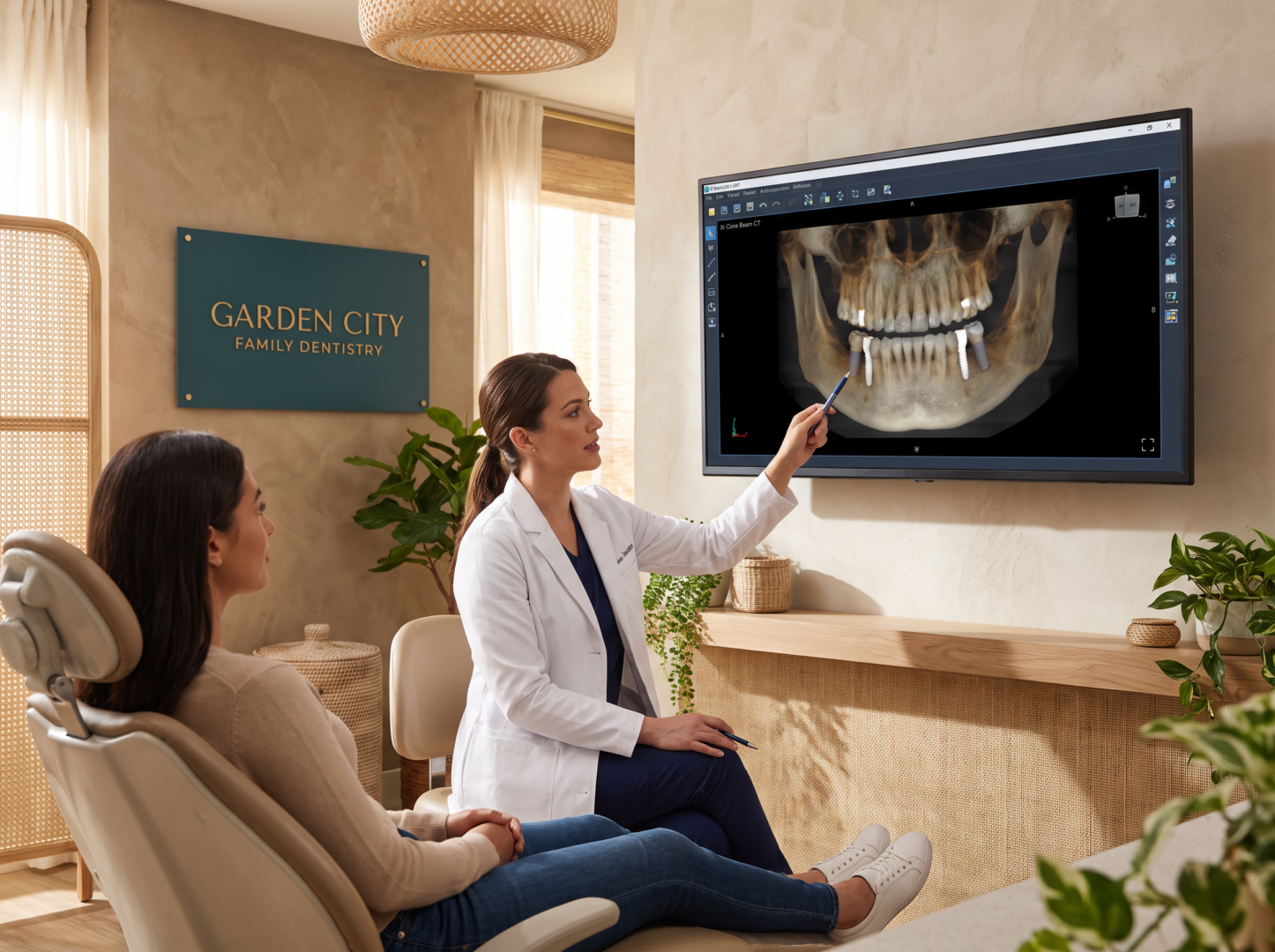
Successful implant placement requires detailed planning. Digital imaging helps the team evaluate your jawbone, nearby anatomy, restoration goals, and the sequence of care.
Detailed images help evaluate jawbone, nerves, sinuses, and the proposed implant location.
Planning tools can support accurate implant positioning when appropriate for the case.
Discuss the planned crown, bridge, or denture and how it should work with your smile and bite.
We review your oral health, goals, medical history, bone structure, and restoration options.
When appropriate, the implant post is placed in the jawbone using the comfort plan discussed with you.
The jawbone needs time to heal and integrate with the implant before the final restoration is connected.
After healing, a connector may be attached to prepare for the custom restoration.
Your custom crown, bridge, or denture is attached and checked for comfort, appearance, and function.
Implants still require daily hygiene and regular dental visits. Your provider will give instructions based on the surgical site and final restoration.
Use the medication, food, activity, and cleaning instructions provided after your procedure.
Maintain the hygiene routine recommended for your implant and surrounding teeth.
Regular visits help monitor healing, gum health, bite, and restoration condition.
Tell your dental team about clenching, grinding, or changes in the way your restoration feels.
Follow soft-food guidance during early healing and gradually return to normal eating as directed.
Contact the office if you experience unexpected swelling, pain, looseness, or difficulty healing.

Implant treatment costs vary according to the number of missing teeth, imaging, surgical needs, bone support, and the final restoration. Garden City Family Dentistry offers financing options for qualified patients.
Ask how insurance benefits may apply, whether additional procedures are needed, and what your estimated out-of-pocket cost and treatment timeline will be.
Explore Insurance and FinancingGarden City Family Dentistry uses local anesthesia and discusses comfort and sedation options when appropriate. Many patients find the procedure more manageable than expected.
With excellent oral hygiene and regular checkups, the implant post can be a long-term solution. The crown or other restoration may require replacement over time due to normal wear.
Yes. Implant-supported dentures use dental implants to help anchor a removable restoration and may improve stability compared with traditional removable dentures.
It depends on bone volume, the location of the missing tooth, and your treatment plan. Digital imaging helps evaluate the foundation before implant placement is recommended.
Your provider will give specific aftercare instructions. A soft-food period is commonly recommended after surgical placement, followed by a gradual return to normal eating as healing progresses.
Garden City Family Dentistry is located at 7110 Venoy Road and welcomes patients from Garden City and nearby communities.
Explore related services and resources before your implant consultation.
Review crowns, bridges, dentures, and other restoration options for damaged or missing teeth.
Explore restorative dentistry →Learn how implant support may help stabilize a removable denture.
View implant dentures →Explore an implant-supported option for one missing tooth.
View single implants →Learn about the custom restoration that may complete an implant plan.
Explore dental crowns →Learn more about the Garden City Family Dentistry team before your visit.
Meet the dental team →Review financing resources and insurance information for treatment planning.
View financing options →Call today or request a dental implant consultation in Garden City, MI.
Find us here
We are delighted to welcome you to our practice and look forward to helping you achieve a healthy, confident smile. Fill out the form below and our staff will contact you promptly.